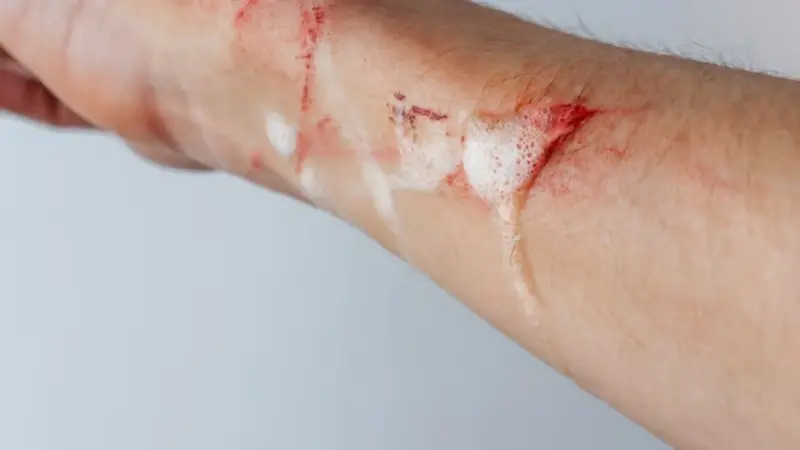
Tattoo pain gets talked about a lot, but most explanations stay on the surface. People usually hear “it hurts” or “it depends on the spot,” without really understanding what that actually means inside the body. The reality is more interesting than the stereotype. Tattooing is a controlled form of repeated micro-injury to the skin, and the sensation you feel is your nervous system doing exactly what it’s designed to do: detect stimulation, evaluate it, and decide how important it is.
Professional studios like Raleigh Tattoo Company (https://raleightattoocompany.com/) and Monochrome Tattoo Studio (https://monochrometattoostudio.com/) tend to explain pain in practical terms because, in real life, most clients don’t experience tattooing as “painful” in the dramatic sense—they experience it as a fluctuating sensation that the body gradually adapts to.
What is actually happening under the skin
A tattoo needle is not like a single puncture. It delivers a rapid series of micro-penetrations into the dermis, the second layer of skin. This layer is where ink is deposited because it is stable enough to hold pigment long-term, unlike the outer epidermis, which sheds constantly.
Each needle entry activates nociceptors, the nerve receptors responsible for detecting potential tissue damage. These signals travel through the spinal cord to the brain, where they are interpreted as pain. But what matters most is that the brain is not just a passive receiver—it actively filters and interprets those signals based on context, expectation, and emotional state.
Neuroscience research from Harvard Medical School explains that pain is not a direct measurement of damage but a constructed experience influenced by attention and expectation (https://hms.harvard.edu/magazine/pain-perception). This is why two people with the same tattoo in the same spot can describe it completely differently.
Why the sensation feels “weird” rather than just painful
Most people expect sharp pain, but tattooing often feels more complex. The closest comparisons people use—scratching, burning, or vibration—are all partially accurate but incomplete.
What makes tattoo sensation unique is repetition. The skin is not being punctured once but hundreds of times per second in a controlled pattern. This creates a layered sensory effect:
- The initial sting from needle entry
- A warming or burning sensation as the skin stays activated
- A dull pressure as the area becomes sensitized over time
Your nervous system starts by treating each stimulus as important, but over time it begins to downregulate its response. This is known as sensory adaptation, where repeated non-threatening stimuli become less intense in perception.
Why placement changes everything
Pain is not evenly distributed across the body because nerve density and skin structure vary dramatically.
Areas like the ribs, ankles, spine, and hands feel more intense because they have:
- Less fat cushioning
- Higher nerve density near the surface
- More bone proximity, which amplifies vibration
In contrast, areas like the upper arm, thigh, and outer shoulder tend to feel more manageable because there is more muscle and tissue to absorb the sensation.
Anatomical research from the University of Michigan Medical School highlights that variations in pain sensitivity are strongly linked to tissue depth and nerve distribution patterns (https://medicine.umich.edu/dept/anesthesiology/research/pain-research). This is why placement is often the most important decision for first-time clients, sometimes even more important than the design itself.
Artists at Raleigh Tattoo Company (https://raleightattoocompany.com/) often guide clients toward placements that match both design goals and comfort level, especially for larger or longer sessions.
The psychological layer most people underestimate
One of the least discussed but most important parts of tattoo pain is expectation. The brain predicts sensation before it happens, and that prediction shapes the experience itself.
If someone expects extreme pain, the nervous system becomes more alert, amplifying incoming signals. If someone expects manageable discomfort, the brain is more likely to classify the sensation as tolerable.
Stanford University pain research has shown that cognitive factors like attention, anxiety, and expectation significantly alter pain perception (https://med.stanford.edu/painresearch.html). This is why people often say, “it wasn’t as bad as I thought,” even when the physical stimulus hasn’t changed.
This also explains why the first few minutes of a tattoo can feel the most intense. The brain is still actively evaluating the situation before it begins to normalize the input.
Why pain changes during longer sessions
Tattoo sessions are not static experiences. They move through phases.
At the beginning, sensitivity is highest because the nervous system is fully alert. After 10–20 minutes, many people enter a more stable phase where the sensation becomes background noise. This is not numbness, but neural adjustment.
However, as the session continues, fatigue can reintroduce sensitivity. The body’s ability to ignore stimulation decreases slightly when energy levels drop, which is why long sessions sometimes feel harder again toward the end.
Experienced studios like Monochrome Tattoo Studio (https://monochrometattoostudio.com/) manage this by pacing work carefully, using breaks strategically, and adjusting session length based on client response rather than pushing through continuously.
The role of control and predictability
One of the most important factors in tattoo comfort is control. When a person feels they can pause the process, communicate, or take breaks, their nervous system stays less reactive. Predictability reduces stress, and reduced stress lowers perceived pain intensity.
This is why professional environments matter. A calm studio, clear communication, and an experienced artist all contribute to reducing the brain’s threat response. Even though the physical sensation is the same, the interpretation of that sensation changes.
After the tattoo: why it feels different
Once the tattoo is finished, the sensation shifts completely. The sharp, active feeling stops and is replaced by a warm, sore, sunburn-like feeling. This is not continued pain from the needle but the body’s inflammatory response, beginning the healing process.
The immune system increases blood flow and sends repair cells to the area, which causes redness and mild swelling. This phase is normal and temporary, and it is part of how the body accepts the ink as stable within the skin.
Final perspective
Tattoo pain is not a single experience—it is a combination of physical sensation, nerve response, brain interpretation, and emotional context. The reason it varies so much between people is because all of these systems are constantly interacting in real time.
What feels intense for one person may feel mild for another, not because the tattoo is different, but because their nervous system is processing it differently. With proper placement, pacing, and an experienced artist, most people find that tattooing is far more manageable than they expected.
Studios like Raleigh Tattoo Company (https://raleightattoocompany.com/) and Monochrome Tattoo Studio (https://monochrometattoostudio.com/) focus on that balance—making sure the technical side of tattooing is precise while also keeping the experience controlled and predictable for the client.